
Distance Is an Asset with an Expiry Date

Updated: 3 days ago
Commentary on “Canada's Digital Sovereignty Advantage: Distance Is Now a Strategic Asset” · Policy Magazine
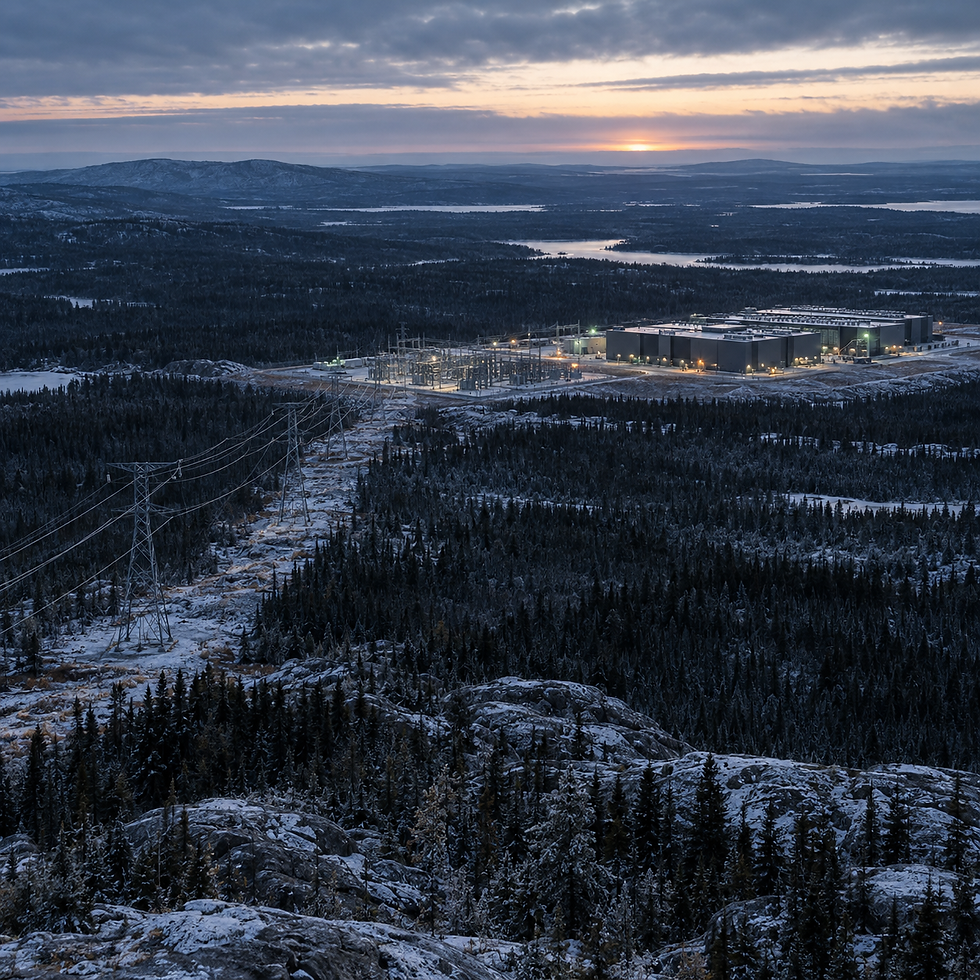
For a month this series has treated sovereignty as something a country builds and controls at home. An essay in Policy Magazine makes the most interesting argument yet by turning that around. Canada's greatest sovereign asset, it contends, may not be the compute it builds for itself, but the distance it can offer everyone else. The argument is right. It also has an expiry date, and the date is set by the interconnection queue.
Richard St-Pierre, writing for Policy Magazine, argues that Canada's advantage in the AI era is fundamentally geographic. Distance from the world's flashpoints is a 21st-century asset. Paired with some of the cheapest clean electricity in the OECD, a climate that halves cooling costs, and stable legal institutions, it positions Canada not just to host its own data but to host allies' data, a "data embassy" model in which a nation under threat keeps its sovereign data on Canadian soil under treaty protection. His precedents are real: Estonia's 2017 data embassy in Luxembourg, carrying diplomatic immunities; Monaco following in 2021; and, most pointedly, Ukraine repealing its own data-localization law and moving more than ten petabytes of state data abroad before the 2022 invasion. Resilience, he concludes, comes from dispersal, and sovereignty is preserved by control, key custody and confidential computing, rather than by physical location. He calls it not a surrender of sovereignty but "the most sophisticated expression of sovereignty available to a state under threat."
The reframe is correct, and it inverts the localization instinct
Most sovereignty policy reaches reflexively for localization: keep the data inside the border. Ukraine is the counterexample that should end that reflex. A country that had fully localized its state data would have concentrated it exactly where the missiles were aimed. Ukraine survived digitally because it had gotten its data out.
St-Pierre's generalisation follows: for a nation under threat, dispersal beats concentration, and a distant, stable, treaty-bound host is worth more than a server in the capital. That turns Canadian geography, long filed as a cost, remote, cold, far from everything, into the product. Remote is safe. Cold is cheap cooling. Far is defensible. This series has argued for siting compute where the power is and the people are not. St-Pierre extends the same logic to the map of geopolitical risk.
But "control, not location" is a specification, not a treaty
Here the series has to press the essay where it is thinnest, the same way it pressed the Bell announcement. Sovereignty through control, national key custody, confidential computing, is exactly right in principle and load-bearing in practice, which means it has to be real rather than asserted. A data embassy is sovereign for its guest only if the host genuinely cannot read the data, cannot be compelled to surrender the keys, and cannot quietly copy it.
St-Pierre names the hard version himself: Canada is a Five Eyes member with no CLOUD Act equivalent, which cuts both ways. Hosting an ally's data in Canada delivers sovereignty only if the custody architecture puts that data beyond Canada's own intelligence reach as much as Washington's. That is achievable, hardware-anchored key custody and confidential computing are how, but it is an engineering and legal specification the guest can audit, not a diplomatic adjective. Estonia's model works because the immunities and the cryptography are both written down. A data embassy is a promise that has to be provable.
And the asset is perishable, because the deadline is the grid
The most easily missed line in the essay is the third recommendation: resolve grid interconnection before 2027, or hyperscaler commitments will lock in American infrastructure. That is this entire series in a single sentence, arriving inside an optimistic thesis.
Distance, clean power, and cold are permanent geographic facts. The ability to use them is not. It depends on connecting new load to power on a timeline, and if Canada's interconnection queues run their usual multi-year course, the window to capture this advantage closes while the paperwork is still pending, and the allied data goes to whoever could actually build in time. A strategic asset you cannot connect to the grid before the decade turns is a strategic asset you will read about other countries using. Geography gives Canada the edge. Time-to-power decides whether it keeps it.
The Canadian read
This is, for once, mostly good news, and worth saying plainly after a run of harder pieces. Canada has a genuine, durable, slightly counterintuitive advantage: it is a safe, cold, clean-powered, legally stable place far from the world's flashpoints, at exactly the moment those became the qualities sovereign infrastructure is judged on. The opportunity is not only to build sovereign compute for Canadians, but to become the trusted host for allies who cannot safely build their own, an export of stability, underwritten by geography.
The two things standing between that opportunity and a missed one are the two this series keeps returning to: a sovereignty that can be verified rather than announced, and a grid that can be connected before the window shuts.
What this means going forward
St-Pierre has written the affirmative case the sovereignty debate has been missing, and it deserves to be taken up rather than admired and shelved. But an advantage is not a policy. Turning distance into a strategic asset means legislating the custody guarantees that make "control, not location" true, and clearing the interconnection and permitting timelines that make the geography usable before 2027. Do both, and Canada hosts the free world's most sensitive workloads. Do neither, and it narrates, again, a natural advantage it could not build fast enough to keep.
Distance is an asset. It is also the only one on this list Canada cannot lose by doing nothing, except that it can, if the thing that turns geography into capacity, a connection to power, arrives too late. The map is in Canada's favour. The clock is not, yet.
VOLTEDGE
Reference: “Canada's Digital Sovereignty Advantage: Distance Is Now a Strategic Asset” · Policy Magazine · read the article


Comments