
Gas Is What The Queue Produces

Updated: 3 days ago
Commentary on “Data Center Gas Plants to Boost US Power Emissions by 20%”· Bloomberg
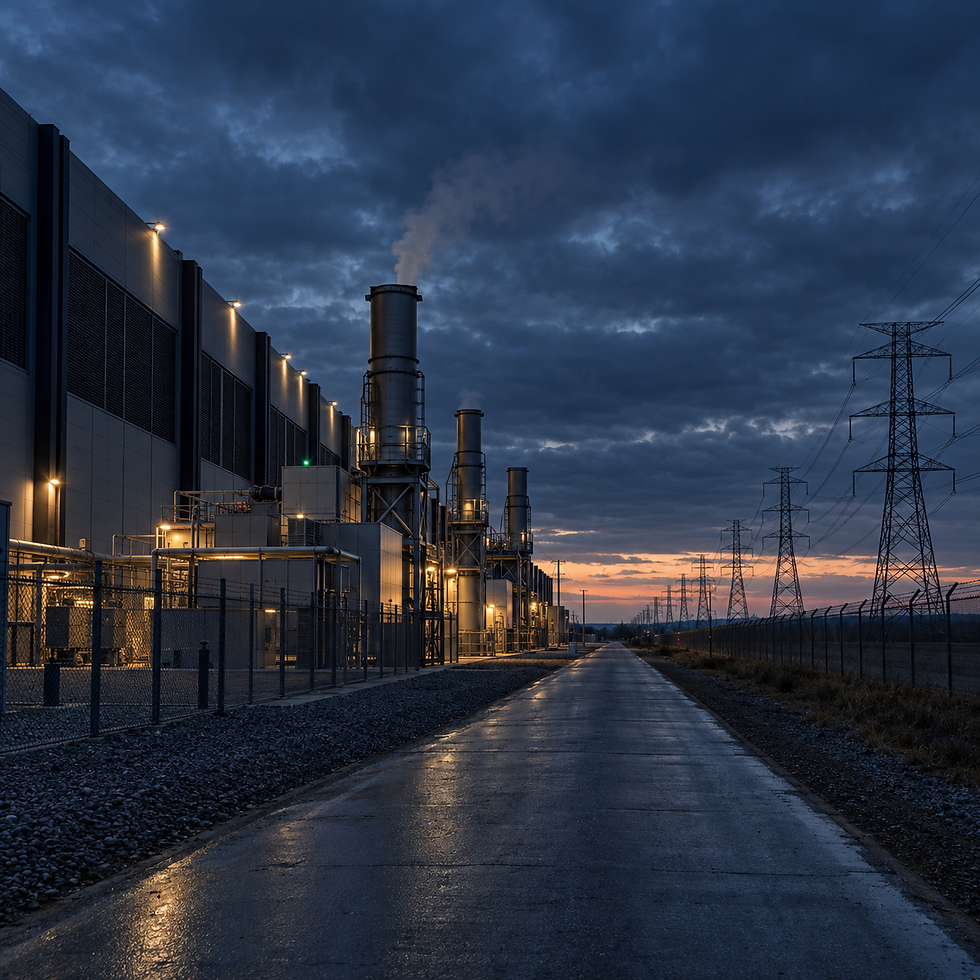
The number in the headline is real and it is alarming: a single category of new infrastructure could raise US power-sector emissions by a fifth. Read as proof that AI is inherently dirty, though, it points at the wrong cause. The gas is not a preference. It is what the queue produces.
Bloomberg, drawing on BloombergNEF data, counts 99 proposed on-site gas plants built to power data centres. Run at industry-standard rates, they would emit roughly 318 million tonnes of carbon dioxide a year. The entire US power sector emitted about 1,485 million tonnes last year, so this one slice of the build-out could lift power-sector emissions by around 20 per cent, and by as much as a third if the plants run flat out. The estimate rests on 126 gigawatts of planned on-site gas capacity across 22 states, more than a third of it in Texas. Two Texas plants alone, serving Amazon and Microsoft facilities, would add some 45 million tonnes. Developers are increasingly reaching for behind-the-meter generation, plants that can be permitted and built without the sign-off of a utility or a system operator, because even approved projects face years-long waits to connect to the regulated grid. A utility watchdog quoted in the piece captured the logic: the sector is under enormous pressure to get power fast, and is "agnostic if it is clean or dirty."
That last phrase is the entire story, and it is not the story the headline told.
The fuel is a function of the timeline
The developers building these plants are not, for the most part, choosing gas over clean power on the merits. The reporting is explicit that they would prefer combined-cycle plants, which are cleaner and more efficient, and are settling for single-cycle units, which are dirtier, because there is a multi-year backlog for the better turbines. They are going behind the meter because the interconnection queue is measured in years.
Strip away the moral framing and what remains is an optimisation with one variable. When speed is the only thing that counts, the answer is whatever can be self-supplied now, and today that is on-site gas in its fastest, dirtiest form. The carbon is downstream of the calendar. Nobody in this story woke up wanting a single-cycle gas turbine. They wanted power before the decade is out, and that is the only thing on the shelf.
This is the queue's receipt
This series has argued that in a rationed grid the scarce asset is a position in the queue. Here is the price of that queue, denominated in carbon.
Every year that a clean, firm, grid-connected megawatt takes to interconnect is a year a developer under this much pressure will bridge with something that needs no one's permission. The 318-million-tonne figure is, in part, a measurement of how slow the orderly path has become. The gas is not winning an argument about climate. It is winning an argument about time, because the clean alternative keeps showing up late.
Behind the meter is behind the public
There is a governance problem folded inside the engineering one. A behind-the-meter plant is built without the utility and without the independent system operator, which are the bodies that plan for reliability and, not incidentally, the venues where the public gets a say. So the emissions do not merely rise. They rise outside the process that would price them, permit them, or let anyone contest them.
It is the same move this series keeps finding in different forms. Solve the problem inside your own fence, secure the power, and let the consequence settle on a commons that had no seat at the table. The data-centre pauses now appearing in Texas and elsewhere are the blunt reaction of jurisdictions that have noticed the fastest option was also the least accountable one.
The clean option has to be the fast option
The instinct is to demand that AI be put on clean power. Correct, and not sufficient, because being agnostic between clean and dirty means the lever that actually moves this is speed, not virtue. A low-carbon megawatt that arrives in 2032 loses to a gas turbine that arrives in 2027, every time, under demand like this.
So the projects that will genuinely displace the gas rush are not the ones with the best sustainability statement. They are the ones that make firm, low-carbon, grid-connected power the fastest thing a developer can buy: sited where clean generation and interconnection already exist, contracted rather than improvised, and planned with the system operator instead of around it. Any emissions policy that ignores the clock will keep losing to the clock.
What this means going forward
The 20 per cent figure will be used to argue that AI and climate goals are incompatible. It is better read as a warning about interconnection speed. Demand of this scale will be met by something. The only open question is whether the fastest available something is clean, and right now it is not, which is a solvable failure of process, turbine supply, and planning rather than a fixed property of computation.
The developers reaching for behind-the-meter gas are telling the grid, in the plainest language available, that it is too slow. The productive response is to make the clean and accountable path faster, because the alternative is ninety-nine gas plants answering the question first.
The emissions are real. They are also a receipt, and what they are billing for is not artificial intelligence. It is the time the grid takes to say yes.
VOLTEDGE
Reference: “Data Center Gas Plants to Boost US Power Emissions by 20%” · Bloomberg · read the article


Comments