
The $600 Billion Assumes a Building

Updated: 3 days ago
Commentary on “Inside the $600 Billion Sovereign AI Gold Rush — and Why Palantir Is Positioned to Win” · Motley Fool / The Globe and Mail
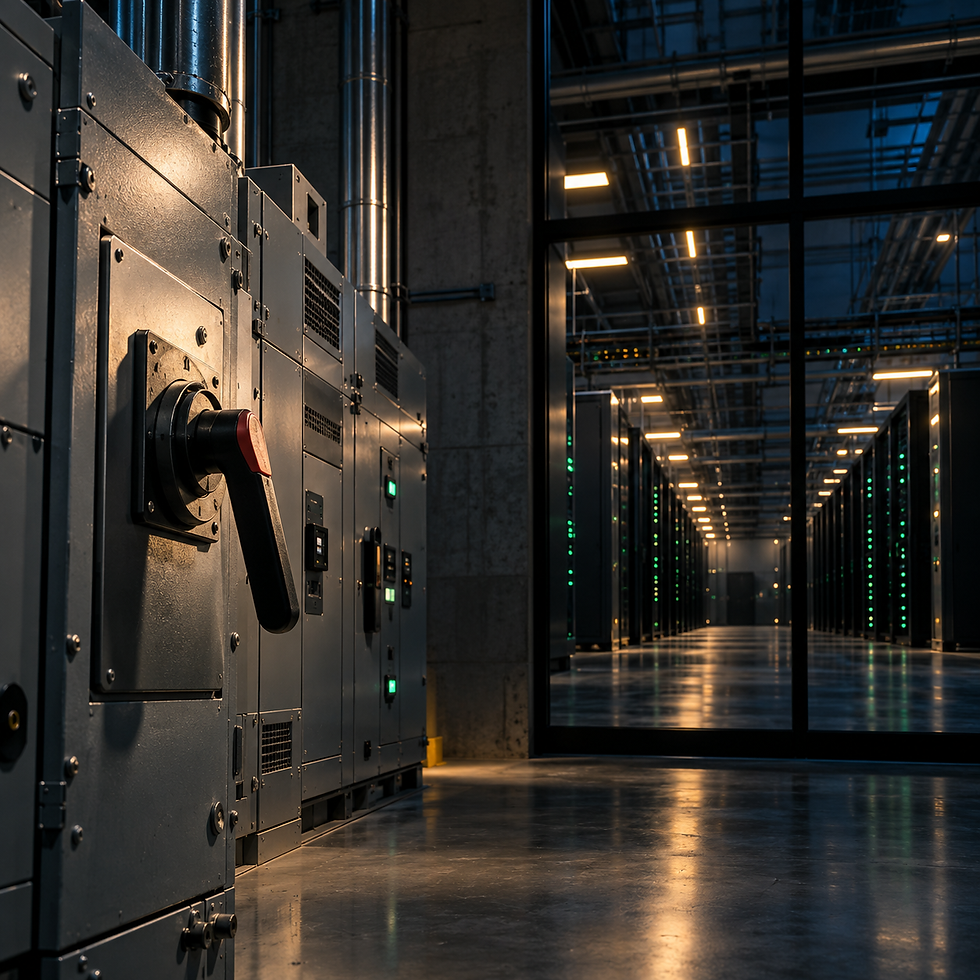
A stock-pitch headline has put a number on something this series has been circling for months: sovereign AI is now a market, and a large one. Hold the number lightly, given where it comes from. Hold the definition underneath it closely, because it quietly concedes the entire argument.
A Motley Fool piece syndicated in the Globe and Mail's markets pages reports a McKinsey estimate that sovereign AI could become a $600 billion market between 2025 and 2030, roughly 40 per cent of all AI demand, and argues that Palantir is positioned to win it. Set the investment thesis aside; it is a stock promotion and should be read as one. The useful part is the definition it offers. Sovereign AI, it says, is not a national chatbot with a flag on it. It is the ability to build, run, and govern AI on your own terms, and it requires four things to converge: where the data and compute physically sit; who can turn the system on and off; who owns the models, the software, and the intellectual property; and which legal system has the last word if something is compromised.
That is a good definition. It is also, read closely, an infrastructure definition wearing a software company's clothes.
Read the four conditions again
Two of the four are purely physical. Where compute sits is a data-centre-and-grid question. Who can switch it off is a question about who operates the facility. A third is ownership of the stack and the IP, and the fourth is jurisdiction, meaning whose law governs the site. Not one of the four is "whose application or ontology layer you licensed."
By the article's own criteria, sovereignty is decided by location, control, ownership, and jurisdiction. And then the article names a software vendor as the winner. The definition and the conclusion are pointing in different directions, and it is the definition that is right.
The software can be excellent and still not be the sovereignty
This is not a knock on Palantir, whose actual competence is real and rare: deploying into air-gapped and classified environments, with permissions, audit trails, and isolation, which is exactly the kind of control this series has argued matters. But notice what that competence needs in order to exist. An air-gapped site, powered, cooled, secured, operated by someone the customer trusts, in a jurisdiction the customer accepts. The software installs into that environment. It does not create it.
The company's own reference architecture is described as a turnkey AI data centre, and that phrase is the tell. The value being sold is inseparable from the building it assumes. The ontology layer governs the data. Something still has to govern the site, the power, and the switch, and that something is infrastructure.
Which is what the $600 billion is really measuring
If sovereign AI is to be 40 per cent of AI demand, most of that money is not application licences. It is the physical and contractual base the applications sit on: controlled data centres, dedicated or governable power, isolation from public networks, and operators inside the customer's own jurisdiction. The software is the visible, high-margin tip. The invoice underneath it is for compute, power, real estate, and the people who run them.
A market sized at $600 billion for "sovereign AI" is, in large part, a market for sovereign infrastructure with a software brand on the box. This series called the same thing a supply chain when Cohere and Aleph Alpha combined, and a dependency that lives in the layer you do not control when the equipment story broke. It is the same point arriving through a stock pitch: the sovereignty is downstairs, even when the margin is upstairs.
The line worth keeping
One sentence in the piece is exactly right, and worth repeating without the stock tip attached: customers are done pretending that "a public API is a long-term strategy." That is the conclusion the OpenAI pause pointed to from the security side and the Cohere merger pointed to from the commercial side. The market has decided that for a large class of buyers, renting intelligence over someone else's endpoint is not sovereign, not governable, and not safe.
What it has not yet fully absorbed is that the alternative is not merely different software. It is different infrastructure, owned or controlled all the way down.
The Canadian read
For Canada the framing matters more than the figure. If sovereign AI is a $600 billion category and most of it is infrastructure, then the question for a country is not which sovereign-AI software brand its institutions buy. It is whether the compute, the power, and the control those applications require sit inside the country and under its law, or are rented back from elsewhere with a sovereign label applied at the top.
A nation can license the most sovereign software in the world and still not be sovereign if it runs on infrastructure it neither owns nor operates. The software is procurable off a price list. The infrastructure has to be built.
What this means going forward
The gold-rush framing will pull attention toward the companies selling the picks: the application layers, the ontologies, the model licences. Those are real businesses and some will do very well. But the definition in the same article tells you where the sovereignty actually lives, and it is not in the pick. It is in the ground the mine is dug into: where the compute sits, who powers it, who can turn it off, and whose law applies.
Those are infrastructure questions, and they will still be infrastructure questions long after the stock stories have moved on. The $600 billion is real enough as a direction, whatever the exact figure turns out to be. Just read what the number is buying. Most of it is a building, a connection, and a switch, and the right to call those yours.
VOLTEDGE
Reference: “Inside the $600 Billion Sovereign AI Gold Rush — and Why Palantir Is Positioned to Win” · Motley Fool / The Globe and Mail · read the article


Comments