
The Constraint Is Time, Not Capital

Updated: 3 days ago
Commentary on "$4.6-billion power station to supply data centre near Edmonton gets green light" · Financial Post
Most coverage of AI infrastructure still treats the data centre as the asset and the electricity as an input. A financing announced in Alberta this month inverts that. The building is not the subject of the deal. The power is, and the entity that will eventually put servers in the building is not on the cap table at all.
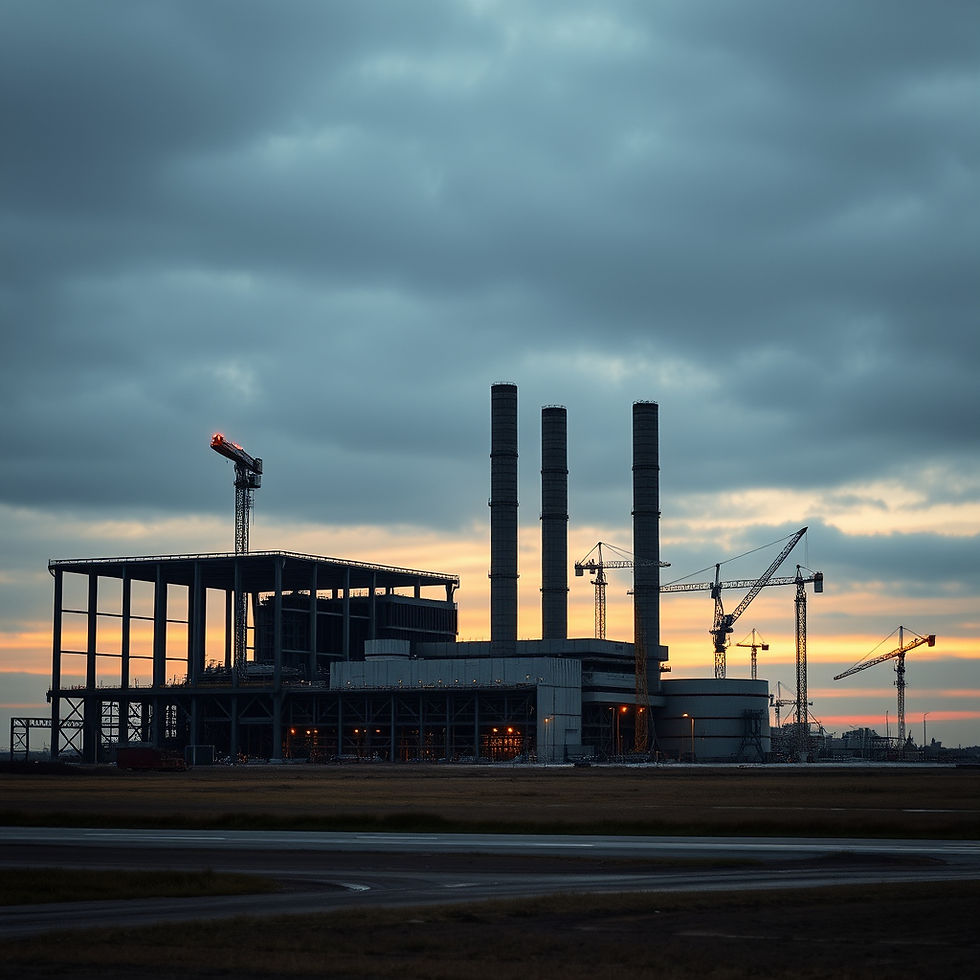
The Financial Post reports that Pembina Pipeline Corp., Morgan Stanley Infrastructure Partners, and Calgary's Kineticor Asset Management have taken a final investment decision on the Greenlight Electricity Centre, a $4.6 billion, 932 megawatt generating station northeast of Edmonton built to serve a single data centre customer the partners decline to name. Analyst research has pointed to Meta. The project has all regulatory approvals, drew no challengers in review, sits on land Pembina already owns, and will consume roughly 150 million cubic feet of natural gas per day. It is expected to run in the second half of 2030.
The obvious reading is that Alberta has won something. The more useful reading is in the calendar.
What the cap table says
Pembina holds 47.5 per cent, the Morgan Stanley group holds 47.5 per cent, and Kineticor holds five. A pipeline company, an infrastructure private equity arm, and an independent power developer. No technology company appears in the ownership at all. The compute buyer is a counterparty on a long-term contract, not a partner in the asset.
That structure is the signal. Generation dedicated to compute has been reclassified as core infrastructure, financed the way a pipeline or a toll road is financed, by investors who want a contracted cash flow over decades and have no particular view on artificial intelligence. Kineticor's chief executive noted the expansion to double output is already permitted and could serve either a data centre or the grid, which is precisely how an infrastructure owner thinks. The load is fungible. The asset is not.
For anyone raising capital in this sector, that reclassification changes the conversation. The question is no longer whether an AI thesis is credible. It is whether the power is contracted, permitted, and bankable, and whether the counterparty is investment grade.
Four and a half years, with everything going right
An Enverus analyst quoted in the piece makes the observation that should reorganize how the industry thinks about competitive advantage. Two committed counterparties, full regulatory approval, land already owned, no opposition at hearing, and $4.6 billion of capital, and the facility still does not operate until the back half of 2030. His point is blunt: it tells you how hard these things are to build.
That is the binding constraint in this business, and it is not chips and it is not capital. It is the elapsed time between a decision and a megawatt. Everything else in the sector is currently repricing around it. A project that can shorten that interval by using generation that already exists, interconnection that already exists, structures that already exist, and permits that already exist is not offering a cheaper facility. It is offering an earlier one, into a market where the difference between 2028 and 2030 is the difference between serving demand and reading about it.
The scarcity is real and it is durable. Announced capital in this sector now vastly exceeds the industry's ability to convert it into operating megawatts. That gap does not close by announcing more capital.
Behind the meter answers one question and reopens another
Pembina's chief executive says the station has "been designed to have limited to no impact on the grid." That single sentence is the most important thing in the announcement, because it concedes the point that Toronto, Hamilton, and New York have all been arguing. Grid impact is now the licence to operate. An operator that can credibly claim not to compete with households for electricity has removed the objection that is currently freezing projects elsewhere.
It has not removed every objection. Greenlight will burn 150 million cubic feet of gas a day, with long-term transport commitments across Pembina and TC Energy systems. A climate think tank cited in the piece notes that this volume, arriving alongside federal ambitions to expand liquefied natural gas exports, creates competition for the gas Albertans use to heat homes and generate power, with the potential to raise prices. The ratepayer exposure did not disappear. It changed units, from electrons to molecules, and moved to a commodity market that is harder for a provincial regulator to reach.
The local response is instructive for its neutrality. Sturgeon County's mayor says the county was not seeking data centres and will not block industry that satisfies its land-use bylaws, on the reasoning that choosing which sectors to permit is a slippery slope. That is the same as-of-right posture Toronto is currently reconsidering. Meanwhile a resident forty kilometres away has signed a House of Commons petition seeking a moratorium on hyperscale facilities across Alberta. The province that has gone furthest to attract this industry now has the same argument running underneath it as the provinces that have not.
Worth noting quietly: the generation is Canadian, the gas is Canadian, roughly half the equity is American infrastructure capital, the likely offtaker is American, and the exposure to gas price competition is Albertan. That is a defensible commercial structure and a reasonable outcome for the province. It is also worth being clear-eyed that Canada's largest dedicated compute power project is, in ownership terms, a partly foreign asset serving a foreign customer.
Alberta set out to attract $100 billion of data centre investment by 2030. One project may take it much of the way there. Whether that counts as a strategy or a single large transaction
depends entirely on what gets built behind it, and on how quickly.
VOLTEDGE
Reference: "$4.6-billion power station to supply data centre near Edmonton gets green light" · Financial Post · read the article


Comments