
The Data Centre Is No Longer the Project

Updated: 3 days ago
Commentary on "Carney, locked in U.S. trade war, pitches Canada to global investment titans" · Reuters
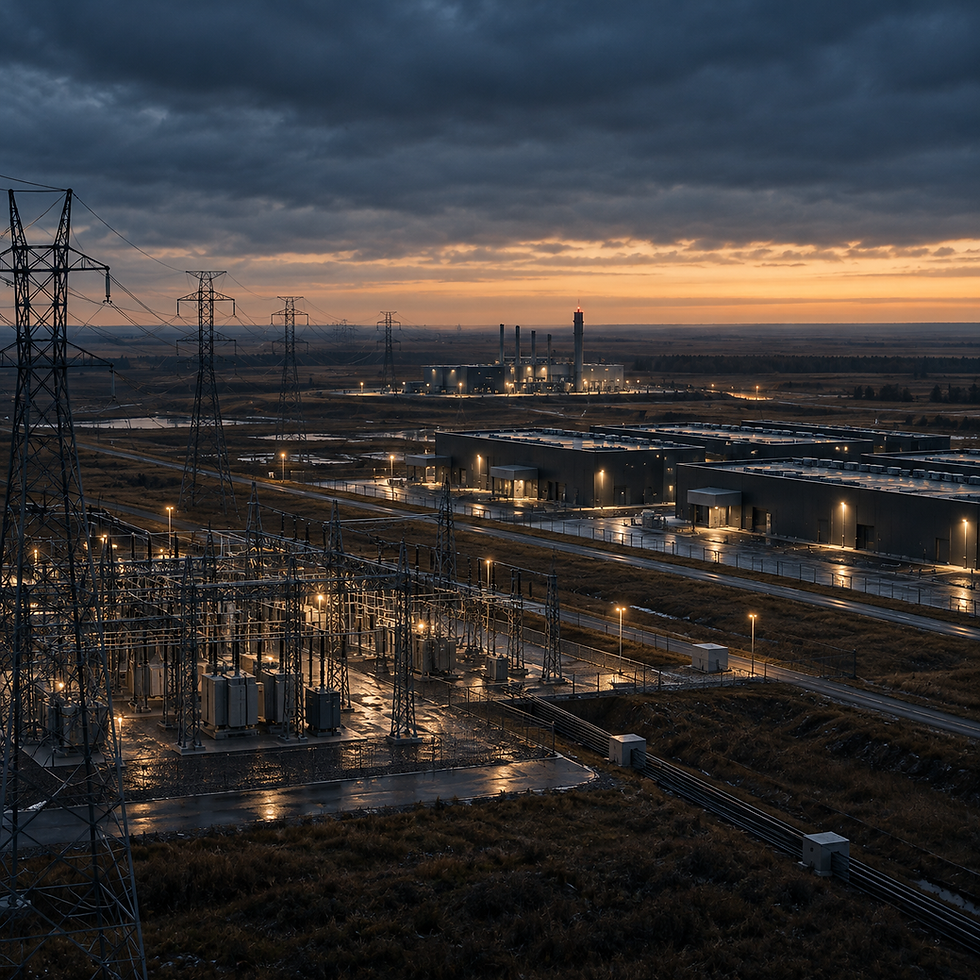
The Data Centre Is No Longer the Project
A fourfold expansion of a Saskatchewan data centre, announced this week, is being reported as a larger data centre.
That description is accurate, and increasingly useless.
Bell Canada has expanded its Saskatchewan AI infrastructure plan from 300 megawatts to as much as 1.2 gigawatts at full buildout. The additional 900 megawatts would push projected capital investment above $50 billion and establish the Bell AI Fabric headquarters in the province. Prime Minister Mark Carney called it the largest sovereign AI infrastructure network in the country. Bell and the Government of Saskatchewan have both confirmed the expansion.
At that scale, the data centre is no longer the project. It is the visible component of a much larger infrastructure system.
A 1.2-gigawatt computing campus requires more than server halls. It requires generation, transmission, substations, fibre, cooling, security, land, regulatory approvals, municipal consent and a financing structure capable of surviving several phases of construction.
Each component must arrive in the correct order. A delay in any one of them can strand the others.
This changes the relevant unit of analysis.
At 30 megawatts, a data centre can still be discussed principally as a building with a large electrical connection. At 300 megawatts, it becomes a significant industrial load. At 1.2 gigawatts, it becomes part of provincial electricity planning.
The distinction matters because the public discussion still tends to begin with the building. How many jobs will it create? How much land will it occupy? How much water will it consume? Those are necessary questions, but by the time the building is being debated, many of the decisions that determine whether the project is viable have already been made elsewhere.
The decisive questions concern the system around it.
Where will the incremental electricity come from? Who pays for the infrastructure required to deliver it? Is the supply firm or interruptible? Can the facility operate independently during a grid disturbance? Does the development increase generating capacity, or compete with existing customers for constrained supply? What happens to the economics if the interconnection schedule moves by three years?
These are not secondary engineering details. They determine whether the project exists.
Alberta has already made this explicit. The province reports that approximately 19,565 megawatts of proposed data-centre demand had entered its connection process by the end of July, while the first 1,200-megawatt allocation is fully subscribed. Projects that bring dedicated generation or storage are being prioritized. The queue is no longer merely administrative. It is selecting which business models can proceed.
Saskatchewan has taken a different route. Bell's development is being framed as a coordinated provincial undertaking built around power availability, Canadian data sovereignty and long-term economic development. The Saskatchewan expansion demonstrates what happens when compute planning and energy planning are treated as one exercise.
None of this is unique to Canada. Wherever the AI buildout meets a constrained grid, from Virginia to Texas to Ireland, the same reordering is underway. Power availability, not real estate, now decides which projects are real.
Capital is beginning to organize itself around the same idea.
BMO has announced an intention to mobilize as much as $70 billion for sectors including power generation and AI computing. Sun Life has launched a $5 billion Canadian infrastructure initiative. TD has committed $150 billion over five years across energy, digital infrastructure, AI and other strategic sectors. Reuters reports that the federal investment summit is presenting global investors with 96 Canadian data-centre developments.
The numbers are enormous, but they should not be mistaken for solved financing.
Capital commitments are not project commitments. Banks can announce lending capacity quickly. Electricity systems cannot announce transmission capacity into existence. A transformer still has to be manufactured. A substation still has to be designed and permitted. Generation still has to be financed, constructed and synchronized. The physical sequence remains stubbornly indifferent to the size of the capital pool.
That is why the most valuable data-centre projects may not be the ones with the largest opening capacity. They may be the ones with the most credible sequence.
A project that begins at a smaller scale but has secured land, expandable power, an interconnection pathway, low-water cooling and a repeatable financing structure may be more valuable than a much larger proposal whose electricity exists only in a presentation.
Federal policy is moving in the same direction. Canada's Responsible Data Centre Development Principles, published on 3 September by Innovation, Science and Economic Development Canada with the Federation of Canadian Municipalities, set five expectations for a project: create lasting local benefits; do not shift electricity costs to Canadians, which means paying for the generation, transmission and substations a project drives; minimize water use and environmental impact; be transparent about local impacts, with independently verifiable figures for power, water, sound and emissions; and bring strategic value to Canada. The principles are voluntary and carry no funding. But they define the terms on which host communities and investors now judge a project, and the signatories already include most of the industry, from Amazon, Google and Microsoft to Bell, TELUS, ThinkOn and Hypertec.
The principles are voluntary. But they define the terms on which host communities and investors now judge a project.
Cooling is no longer just a mechanical specification. It is a water-policy position.
Dedicated generation is no longer just a reliability measure. It is a ratepayer-protection argument. Community engagement is no longer just a permitting step. It is a reporting obligation.
Sovereign compute is no longer simply a customer category. It is a national-security and industrial-policy proposition.
The Saskatchewan announcement is therefore important for more than its size. It establishes a new reference point for what governments and institutional investors may mean when they speak about AI infrastructure.
They are not describing isolated buildings filled with processors.
They are describing regional systems in which electricity, compute, capital and public policy are planned together.
The data centre remains where the computation happens. But the platform around it is now the project.
VOLTEDGE
Reference: "“Carney, locked in U.S. trade war, pitches Canada to global investment titans” Reuters


Comments