
Zoning Cannot Fix a Grid Code Problem

Updated: 3 days ago
Commentary on "AI data centres are becoming the workhorses of the internet, but cities aren't sure what to do with them. Here's why" · CP24
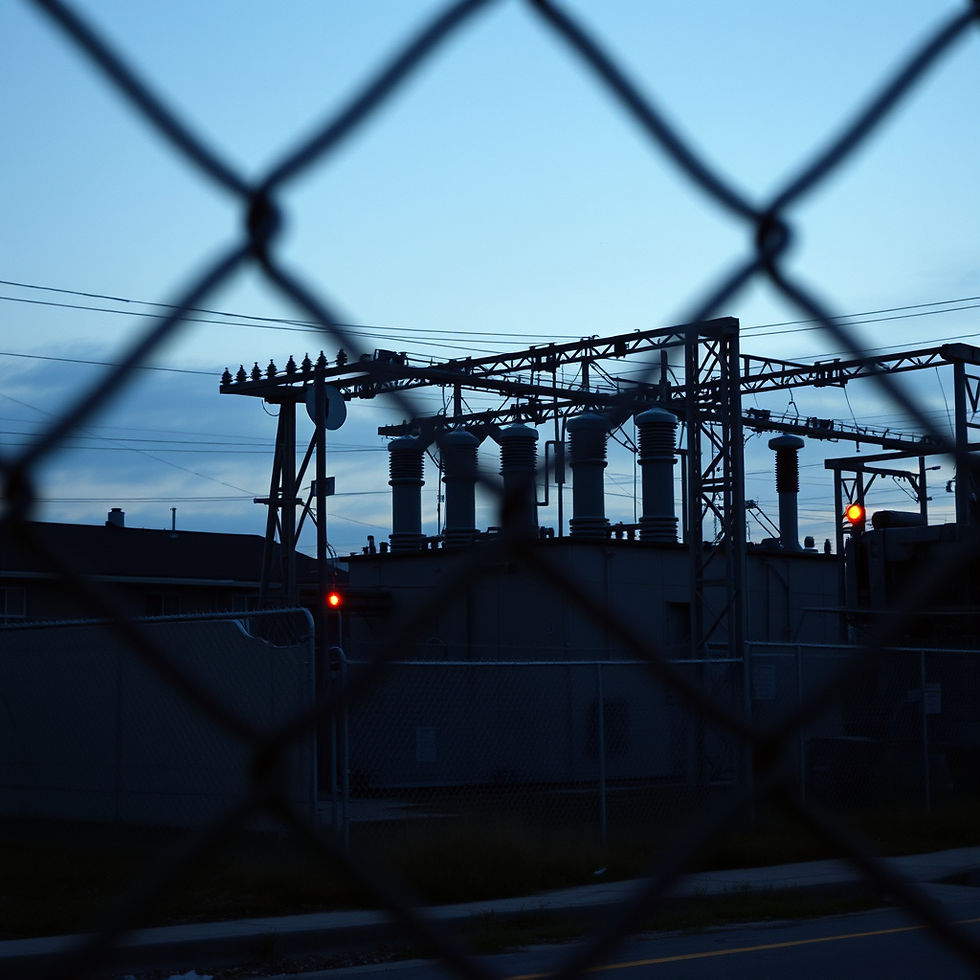
Municipal land-use planning is a deliberately slow instrument built for a slow problem. It decides what may be built where, on horizons measured in decades, through public process. It is now being asked to referee a reliability question that resolves in twenty milliseconds.
CP24 reports that Toronto councillor Dianne Saxe, who also sits on the Toronto Hydro board, was prompted to bring the matter to council after the North American Electric Reliability Corporation issued an urgent level-three alert concerning what it calls computational load entities. NERC found that utilities serving this fast-growing category largely lacked the processes and methods to manage the risks it presents. Saxe, an environmental lawyer, described the alert as a "3-alarm fire" from a body not given to sending up flares. The mechanism she describes is precise. Protective equipment inside large AI facilities can disconnect the facility within twenty milliseconds of a voltage disturbance small enough that household lights would not flicker. Six or seven such facilities on the same section of grid, reacting to the same disturbance at the same instant, can destabilize it.
The public debate has been about how much electricity these buildings consume. The regulator's concern is a different one. It is about what they do at the moment something goes wrong.
A different kind of load, not simply a bigger one
A Western University computer scientist quoted in the piece traces the progression cleanly: data centres were once a moderate draw, then the equivalent of a large industrial facility, and on some grids they are now the primary consumer and still scaling. That is the part everyone has absorbed. The part that has not landed is that scale is only half the change.
Traditional industrial load is dispatchable and legible. It ramps, it runs on shifts, it answers the phone when the system operator calls. A large training cluster is flat, constant, and protected by equipment whose entire purpose is to disconnect it very quickly. That protection is rational at the level of the individual facility and hazardous in aggregate, because the facilities are not independent actors. They are a fleet of machines with identical reflexes wired to the same nervous system.
Grid engineers already have language for this. It is a question of ride-through performance, curtailment obligation, ramp limits, and telemetry, settled through interconnection agreements and enforced through connection standards. Those standards exist in mature form for generators. For loads of this class and this behaviour, they largely do not exist at all.
Zoning is the wrong instrument
Toronto is studying whether AI facilities should be pulled out of as-of-right industrial zoning into a category of their own. Hamilton's planning committee went further, before full council rejected a one-year pause on July 15. The councillors are right that something is missing. A zoning bylaw is simply not the thing that is missing.
A land-use category can govern setbacks, noise, water servicing, and whether a use is permitted at all. It cannot specify how quickly a facility's protection relays are allowed to open, or oblige an operator to hold load through a fault. Rezoning gives a city a veto, and nothing finer than a veto.
A veto is expensive in both directions. The Microsoft conversion of a former retail site in Etobicoke, tunnelled beneath a provincial highway to reach dedicated junction stations, is a project whose sponsor states publicly that it is paying the full cost of the grid assets it requires. Whatever one makes of that claim, it is a claim that can be tested. A blunt zoning category cannot tell that project apart from one making no such commitment. It treats a facility that pays for its own interconnection and a facility that socializes the cost as the same land use, because in land-use terms they are.
The province holds the right instrument and will not describe it
Ontario's energy legislation already permits the province to set criteria data centres must satisfy before connecting to the grid. That is the correct lever, held at the correct level of government. But the statute does not state what the criteria are. Asked where the guardrails are written down, the ministry did not answer.
The result is predictable. Municipalities reach for the only instrument they actually control, and a technical standard that nobody has drafted gets litigated as a series of land-use fights, council by council, on evidence that councils are not equipped to weigh. The province counts roughly a hundred AI data centres in Ontario as of 2025 and promises a strategy. The reliability corporation has already told everyone what the strategy needs to contain.
Why this matters for Canada
A York University researcher quoted in the piece found that his group's data was sitting in a facility on fossil-heavy American supply, moved it to a Quebec region fed by hydroelectricity, and cut the associated emissions by roughly 87 per cent. One customer, one selection, one order of magnitude. That choice existed only because Canadian capacity existed to choose.
Ontario frames its connection legislation partly around keeping Canadian data in Canada. Sovereignty is now being written into grid connection law, which is a development worth noticing. It also cuts both ways. A connection standard drafted well makes room for operators who bring their own power solution and their own balance sheet. Drafted badly, or left undrafted while moratoriums accumulate, it defaults to whoever can afford to wait, and the parties who can afford to wait are the largest foreign incumbents.
What this means going forward
Toronto and Hamilton both have staff reporting back next year. The useful output is not a new zoning class. It is a connection performance standard the province adopts, utilities enforce, and municipalities can then rely on instead of improvising.
For operators, the implication is immediate. Grid behaviour is about to become a condition of connection rather than a courtesy. Facilities that can demonstrate ride-through, accept curtailment terms, and fund their own interconnection will be permitted. Facilities that present as an undifferentiated block of demand will be treated as a reliability risk, because the reliability corporation has now put in writing that they are one.
The councillors are not wrong to be alarmed. They are simply the wrong people to be left holding the alarm.
VOLTEDGE
Reference: "AI data centres are becoming the workhorses of the internet, but cities aren't sure what to do with them. Here's why" · CP24 · read the article


Comments